
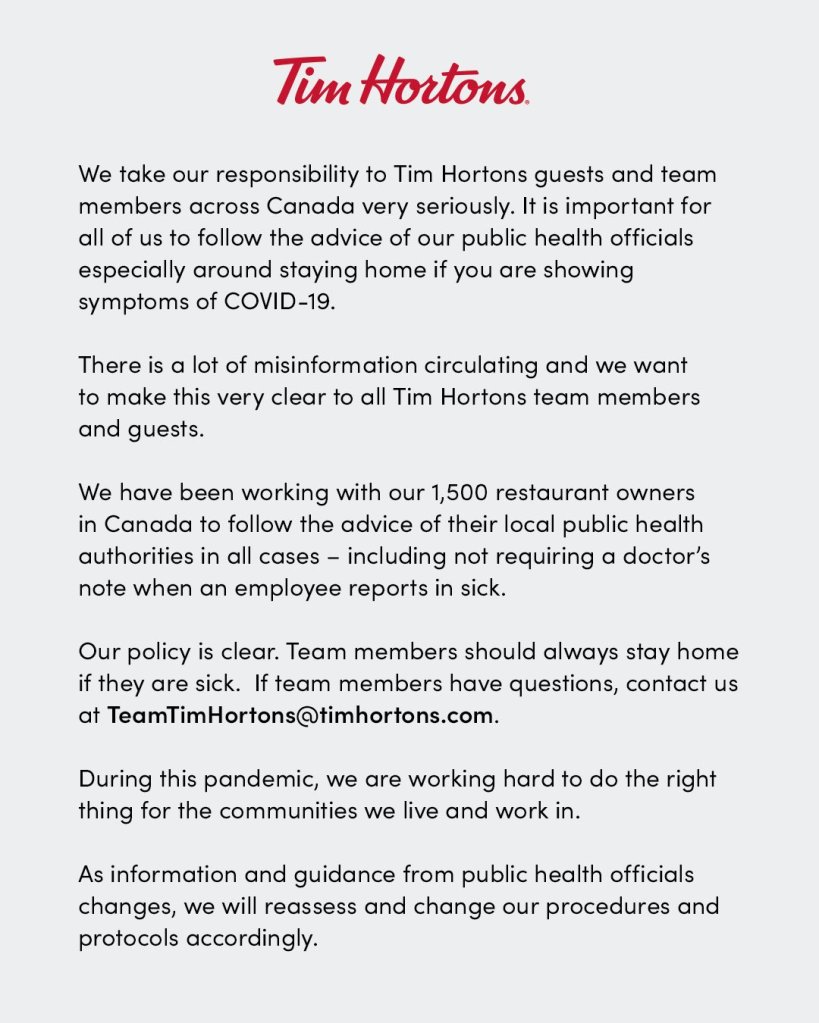
The international response to COVID-19 has stripped down each government, organization, and corporation to reveal exactly what policies they have in place to protect their staff, their clients, and the broader community. And where they are sorely lacking. Take Tim Horton’s, who is under fire for reportedly forcing sick staff to work or get a doctor’s note to return to work, which Tim’s has vehemently denied. But so far they have remained silent about the fact that they enforce this “sick policy” but with no compensation for staff predominantly making less than living wage at stores.
Then there’s government.
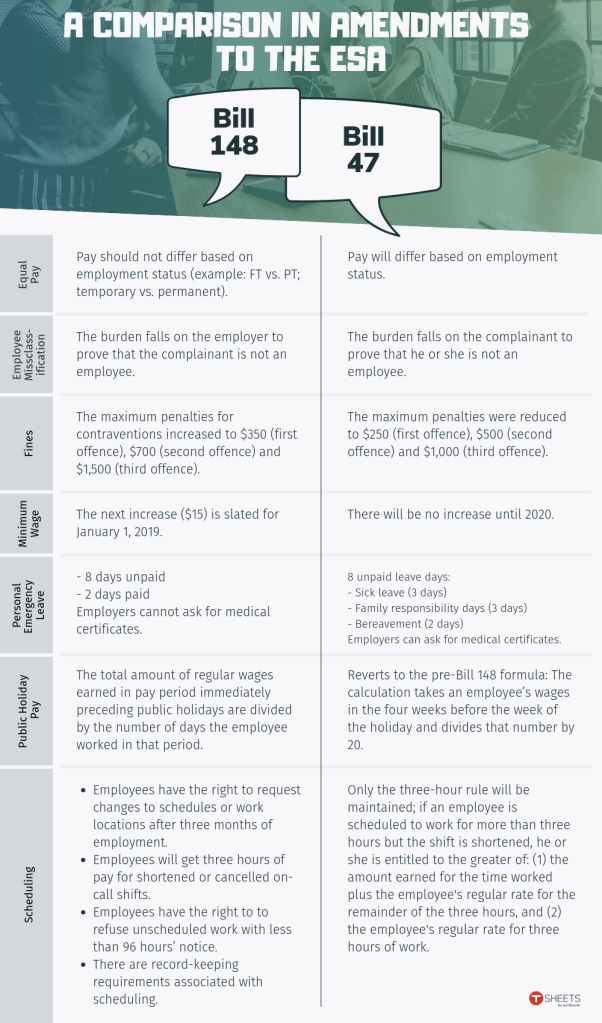
Within months of being elected in 2018, the Ford government passed the Making Ontario Open for Business Act (Bill 47) that stripped workers of the 10 days of sick leave, two of which were paid, and replaced them with three unpaid sick days. The previous minimums had been introduced just that year by the Wynne government in A plan for fair workplaces and better jobs (Bill 148). Ford’s bill was also the one that froze the minimum wage increase and tied it to inflation, despite $14/hour being far below the living wage for many places across Ontario.
Now, faced with a very public and clear understanding of why three days doesn’t cut it and the reality that unless it’s paid leave, not many can afford to take it, this government will hopefully reconsider and the province will emerge from this crisis with an even stronger leave policy that sees people taking the time to recover at home when needed and to care for those requiring support, without penalty to their income or a risk of losing their job.
But social responsibility doesn’t stop there. It’s easy to tell the government and major corporations what they’re doing wrong. Sometimes really easy. We do it all the time. It’s much harder to see how our own judgements of other people’s greed, absorption, and narrow-mindedness are actually hypocritical given our own personal decisions. To reframe in a less blame-y, more positive light: each individual has the power to ensure safe and inviting workplaces, equitable compensation, and a healthier community. But it requires ownership over your own actions (hard to do), accountability for your past mistakes (even harder to do), and the drive and dedication to make changes moving forward (the hardest to do).
Below are ways in which individuals can grow their community as opposed to standing on the sidelines, waiting for a greater (and possibly greedier) power to step in:
Swapping what you want for what others need
You didn’t panic. But you were trying to be “prepared” when you bought 10 cases of bottled water, 26 litres of milk, the entire store inventory of tampons, and all of the boxes of Kraft dinner you could find. But that’s done. Move on. Let’s do better.

Upon reflection you realize you don’t even have room in your apartment for all the vinegar you bought to disinfect… you’re not sure what, but COVID-19 in general. So do something about it. If you have more than you need, find a way to give it to those who have less than they need. Think neighbours, family, friends, local shelter, or one of the many agencies that support vulnerable populations. It could be your extra food, your household items, or even a monetary donation in lieu. Here are some options to get you started:
- Daily Bread Food Bank (serving 150+ agencies across Toronto)
- London Food Bank
- North York Harvest (serving northern Toronto)
- Mississauga Food Bank
- Ottawa Food Bank
- Regional Food Distribution Association (serving the Thunder Bay area)
Are YOU an employer? Probably. And your home is the workplace.
Reliable statistics on how many people pay “in cash” is hard to find, mainly because the point is to have no paper trail. But it’s likely very high, given how many people’s cleaning service is an envelope of cash ($80/4 hours maybe?) left on the counter for when the “cleaning lady” is done, or how many tutors get paid with a twenty at the end of their session, or the regular after-school sitter or dog walker who gets the monthly eTransfer, or the local “handyman” who finally painted your ceilings for a hundred less than what you would have paid otherwise. If you pay someone in “cash”—to be clear, it may be cash, cheque, money transfer, but the point is there’s no tax or record—you are employing that person and YOU are responsible.
“But they are self-employed!” you may say defensively, as you sip your $7 Starbucks you can indulge in thanks to the 10%-80% you save by not hiring services the “traditional” way. And yes, they are. But you also employ them and they often rely on your business to earn a living. But this article is not about the moral or social implications of paying under the table (so much to unpack there for another time), it’s about what people can do now, moving forward to ensure that if they do take part in these practices, that they do so in a way that promotes a healthy workplace. And how exactly can that be done?
CANCEL WHEN YOU ARE SICK
With as much notice as possible, cancel your at-home hair-dresser, cleaning service, babysitter, neighbourhood plumber if you or someone in your household is not well. Ensure that whomever you are employing stays home if they’re sick. Likely if you’re paying under the table it’s not an emergency and it can definitely wait until whomever is sick feels better. Your new hairstyle isn’t worth passing along that gastrointestinal bug you’ve had for two days.
PAY YOUR HIRED HELP FOR MISSED APPOINTMENTS/SESSIONS

Be it sick days, statutory holidays, or for that 40th birthday your dog groomer wanted to spend not grooming little Rufus. If you’ve budgeted x number of dollars for your guitar teacher each week, it won’t put you out to pay it on the couple of weeks per year that they don’t work. You’re treating the worker like a person when you pay for missed shifts. And if you’re one of the fortunate ones who gets paid sick leave, or more importantly if you’re one of those that does not, you’ll understand how very critical that can be. And you can spend that week practicing, because you could always use more practice.
TALK ABOUT IT
Have the discussion with friends, family, coworkers, random chatty tourist on the subway about this topic. Share your perspective (and hopefully this one).
Understand that small businesses are built by communities
You love your yoga studio, your local gym, or your weekly toddler time at the local book store. To be able to function physically and emotionally, you rely on that massage therapist, pelvic floor physio, or marriage counsellor. And nights out wouldn’t be the same without the pizza place on the corner. But do you value their services enough to help ensure they survive dips in business or full-out COVID-19-level pandemics? Hopefully the answer is yes.

And if it is, consider paying all or part of the registration costs or session fees when you are unable to attend, or bringing the service to you such as ordering out. Hardest hit by ongoing fear and panic, outside of vulnerable populations, are the local and independently owned stores, clinics, studios, venues, restaurants, and activity centres. And while giving enough notice of cancellations when you’re sick or when plans change is just a decent thing to do, it also allows these businesses to fill that gap. But in a pandemic state, there’s no one to fill that gap. So what do those who rely on providing the service to get the funds do when they can’t provide the service? In the worse case scenario, individuals come to rely on social services while the small businesses close down.
Luckily, YOU as part of the community, can help keep the worst from become real. Here’s are some ways:
CONTINUE YOUR MEMBERSHIP
If you have a membership somewhere, consider continuing it through this crisis (for now) and through any illness or temporary leave you may have (for the future). Consider it pre-payment for the joy you’ll receive down the road, or a thank you for the wonderful ways in which the service has enriched your life so far.
CONTINUE TO BUY LOCAL
If your local stores have online services available and you can afford them, turn to them first before hitting up Amazon. Or take advantage of free shipping, pay now/get later, and other ways that local businesses in the Atlantic provinces are adapting to support their community and stay afloat.
ORDER TAKE-OUT
Order take-out from the local restaurant you typically eat at for monthly “date nights” or delivery when you’re sick (some soup or butter chicken is sure to help). Just take measures to protect the safety of the delivery person and yourself, including paying electronically and having the food left at your doorstep, then promptly wiping down packaging before opening.
YOU CANCEL = YOU PAY THE CANCELLATION FEE
If you receive health treatments and are cancelling your session, or it’s been cancelled due to forced closure thanks to COVID-19, consider still paying all or a portion of the cancellation fee. Many clinics are waiving cancellation fees to encourage those who are sick to stay away. But you can still choose to provide the compensation for the time you had reserved as investment in a clinic you hope is still there when this is done. And for future appointments, if you make a last minute change that makes it likely they are unable to fill the gap, that’s on you. Take ownership and take out your wallet (or phone, or watch).
Health services that are covered present a trickier moral dilemma, as many who require these services rely on health plans to cover all or part of the costs for these treatments. If that’s the case, pay what you would have, give as much notice as possible, and book as much as you can once the crisis is over.
Many clinics are waiving cancellation fees to encourage those who are sick to stay away. But you can still choose to provide the compensation for the time you had reserved as investment in a clinic you hope is still there when this is done.
ASK IF THEY OFFER PAID SICK LEAVE TO THEIR STAFF
Pandemic or not, you should know how the businesses you support treat their staff. Ask. Encourage your local independent business to pay their staff sick leave, if they don’t already. Demonstrate that it’s a priority for you as a client and provide examples of how they might budget/plan for it and the serious costs if they don’t.
USE ONLINE METHODS OF COMMUNICATION
Many mental health specialists will conduct appointments over the phone or on a private online platform. Some studios offer online classes (even for free!) through social media. Whatever it is they offer, take them up on it to stay connected, stay supportive, and stay healthy.
Everyone could use a laugh these days
The only way to move forward really, is to believe that every is doing their best (and that hopefully their “best” will be even “better” in the future…too much pressure?). So let’s end on a high note, with possibly the most honest COVID-19 coverage to date:
 Do Better. Be Better.